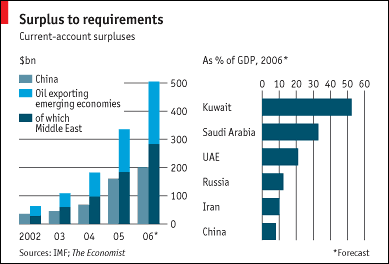
When we think of countries that are hoarding US dollar assets the first country that pops to mind is China. But the increase in oil revenues in recent years has made the Gulf countries perhaps just as important in this regard. According to the Economist:
Counting only the Middle East oil exporters, the surplus has surged from $30 billion in 2002 to an estimated $280 billion this year. One reason why this gets much less attention than the smaller $160 billion increase in China is that only a fraction of it has gone into official reserves, which are publicly reported. Most of it is stashed in government oil-stabilisation or investment funds, such as the Abu Dhabi Investment Authority, which are much more secretive than the People’s Bank of China—but which probably hold just as many dollar assets.
The six members of the Gulf Co-operation Council, or GCC (Saudi Arabia, United Arab Emirates, Kuwait, Bahrain, Oman and Qatar) have fixed their exchange rates to the US dollar. As a result, they are unable to increase interest rates above the rate of inflation and cool down their over-heated economies.
As the Economist points out “only 10% of the GCC’s imports come from America (compared with one-third each from Europe and Asia), so from a trade-weighted point of view, the dollar peg makes no sense.” A more sensible approach would be to peg to a basket of currencies including the US dollar, Euro, several Asian currencies and gold.
Indeed the GCC is already moving towards this direction with the planned introduction of a new unified currency in 2010. Once established, the GCC leadership may decide to invoice their hydrocarbon sales in the new common currency, moving away from the current dollar pricing system. It could also become the reserve currency of choice for Islamic and Arab central banks for a combination of religious and political reasons.
All this could have severe ramifications for the US dollar. Currently, Asian central banks and Gulf countries are the major buyers of the US dollar. Any sort of reduction in this buying could cause the US dollar to tumble.
